Before you save a passport scan, a bank letter or the Wi-Fi password into an app, it's fair to ask where it goes and who can open it. This post answers that for ReticulOS, in plain words first and then in full detail for anyone who wants the specifics. If it leaves a question unanswered, write to us and we'll add the answer here.
The short version
- Everything you save is stored on your own computer, encrypted. We don't have a copy.
- Passwords go in a vault with its own password. Nobody can open it without that password, and that includes us.
- Nothing goes to an AI until you ask Ret something. Then it gets your question, the conversation and the notes it found, and the AI provider doesn't train on any of it.
- We don't sell your data, show you ads, or track what you do in the app.
- Every update is signed, and the app refuses one that isn't.
Your library lives on your computer
When you save something in ReticulOS, whether it's a note, a link, a picture, a PDF or a recording, it goes into a database on your own computer. It isn't uploaded to us. There's no copy of your library on our servers, so there's nothing there to leak, sell or hand over.
That database is encrypted. If someone copied the file off your disk, or took the drive out of a lost laptop, they'd find scrambled data. The key that opens it is made on your computer the first time you open ReticulOS, and it's kept in your operating system's secure storage, the same place your computer keeps saved Wi-Fi and account passwords. ReticulOS opens it for you once you've signed in to your computer, so there's nothing extra to remember.
Saving, organising and searching all work without the internet.
The vault, a second lock only you hold
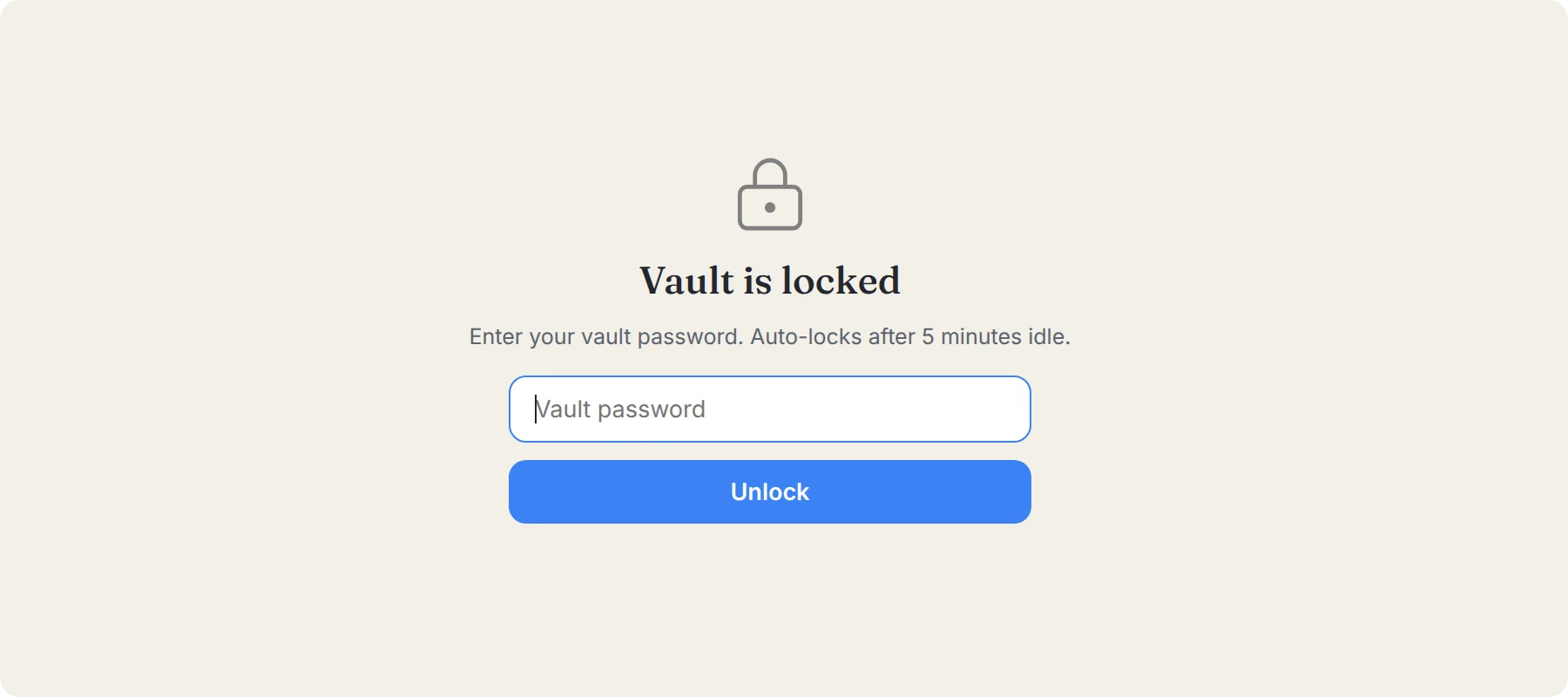
Some things deserve more than one lock. The vault is a separate space for passwords, PINs, codes and keys, and it's protected twice, once by the encrypted database and again by a vault password that only you know.
- Your vault password is never stored anywhere. ReticulOS turns it into a key, opens the vault with that key, and keeps the key in memory only while the vault is open.
- The vault locks itself after five minutes without use, when you close the full window, and whenever you press the lock. When it locks, the key is wiped from memory.
- A password you copy from the vault is cleared from your clipboard after 45 seconds, so it isn't left behind for the next app to read.
- Vault entries are never searched and never added to Ret's index. Ret can't open the vault, and neither can any AI app you connect.
Because the vault password is never stored, there's no "forgot password" link. If the password is lost, the vault stays sealed for good. We built it that way on purpose, so there's no back door for us or for anyone who might ask us to open it.
What happens when you ask Ret
Ret is the assistant in ReticulOS. Writing an answer takes an AI model running in a data centre, so this is the one part of ReticulOS where your words leave your computer. Here's exactly how.
Finding happens on your computer. When you ask a question, ReticulOS works out which of your notes are relevant on your own machine.
Then Ret sends what the answer is built from. That's your question, the last few messages of the conversation, and the notes it found, including any pictures or PDF pages among them. It never sends your whole library, and never anything from the vault.
It goes to Google's paid Gemini service, through ours. Our service checks your plan and passes the request on. It doesn't keep your question or the answer. It only counts how many answers you've used this month. Because we pay for Google's service, Google doesn't use your requests to train its models or improve its products. It keeps them for 55 days to detect misuse, then deletes them.
Nothing happens in the background. Ret only sends something when you ask it to. If you never use Ret, nothing you've saved goes to an AI.
If you choose to use your ChatGPT plan instead, Ret's requests go from your computer straight to OpenAI under your plan's terms and never pass through us.
Connecting other AI apps
You can let AI apps like Claude or Cursor search your notes. It's off until you turn it on. When it's on, the connection only works from your own computer, every app needs a long random token from your settings, and any change an app wants to make waits for your approval. Every action is logged and changes can be undone. No connected app can delete a note for good or open the vault.
What we can see, and what we can't
| What | Can we see it? |
|---|---|
| Your notes, files and recordings | No. They stay on your computer, and we never receive them |
| Your vault | No. Only your vault password opens it |
| What you ask Ret | It passes through our service on its way to Google. We don't keep it |
| Your account | Your email address, your plan, which devices are signed in, and how many Ret answers you've used each month |
| Your card details | No. Payments are handled by Dodo Payments |
| What you do in the app | No. The app has no analytics or tracking |
You can see every device signed in to your account, and sign any of them out, from your account page in the app or on the website. Deleting your account removes it from our service. The privacy policy lists everything we keep and for how long.
How the app protects itself
Encryption protects your data while it's stored. These protect the app while it runs.
- Signed updates. Every update is signed with our release key. Before installing, the app checks that signature and checks the downloaded file against it, so a tampered download can't be installed, even by someone who broke into our download server. Nothing installs until you choose to restart.
- No password of yours for us to lose. You sign in with Google, so we never see or store a password. The app keeps its sign-in encrypted in your computer's secure storage.
- Outside pages stay outside. ReticulOS windows refuse to load web pages. A link in a note always opens in your browser, never inside the app, where a page could reach your data.
- No side doors. Release builds have developer tools and debugging switched off, and the app gives web content no access to your camera, microphone or notifications.
Coming next, built the same way
What it protects against
ReticulOS is built to keep your data safe when:
- your laptop is lost or stolen, or someone copies your disk;
- another app or user account on your computer tries to read your files;
- someone tampers with an update;
- someone breaks into our servers, because your notes aren't there.
The vault adds one more layer. Anyone using your computer while you're signed in to it can open ReticulOS like any other app, but they still can't open the vault without its password. Locking your screen when you step away keeps everything else safe too.
On a few Linux setups the operating system has no secure storage for keys. If that's your case, ReticulOS tells you that your key is less well protected, so you can decide what to do.
Check it for yourself
You don't have to take our word for any of this.
- Try to open your library. Point any SQLite tool at the database file (on Linux it's
~/.config/reticulos-linux/reticulos.db) and you'll get an error, not your notes. - Take everything with you. Export your collections as plain Markdown files at any time, with your pictures and files alongside.
- See who's signed in. Your account page lists every app and browser signed in to your account, and lets you sign them out.
- Watch the network. The app connects to the internet only to check for updates, download its search model once, sign you in, and answer when you ask Ret. The privacy policy lists each one.
The details, for security teams
| Part | How it works |
|---|---|
| Library | SQLCipher 4 (AES-256 with a per-page HMAC-SHA512), under a random 256-bit key from the system's secure random generator |
| Key storage | Electron safeStorage: the Secret Service keyring (GNOME Keyring, KWallet) on Linux, DPAPI on Windows. The wrapped key file is readable by your user only |
| Vault | AES-256-GCM per entry, with a key derived by scrypt (N = 2¹⁵, r = 8, p = 1, 16-byte random salt). Key held in memory only, zeroed on lock, 5-minute auto-lock. Vault data is never indexed |
| Ret requests | TLS to Cloudflare and an encrypted tunnel to our service, then Google's paid Gemini API. Not stored by us. Google keeps abuse-monitoring logs for 55 days and doesn't train on them |
| Sign-in | Google OAuth with PKCE. Refresh tokens rotate on every use and are stored with safeStorage; access tokens live in memory only. Plan grants are Ed25519-signed and verified on your computer |
| Updates | Ed25519-signed release feed. The downloaded package is re-hashed (SHA-512) against the signed manifest right before install |
| App | Context isolation and sandboxed renderers. Navigation and new windows are blocked, web permissions denied, DevTools off in release builds, and the Node inspector and NODE_OPTIONS disabled with Electron fuses |
| Connected AI apps | Off by default. Listens on 127.0.0.1 only, checks Host and Origin headers, and requires a 256-bit bearer token compared in constant time. Writes need approval and every call is audited, with Undo |
| Cloud backup (coming) | Encrypted on your computer with AES-256-GCM and HKDF-SHA256 subkeys. The backup key is stored only wrapped under a 160-bit recovery key we never receive |
If you have a question about security, or you've found a problem, write to contact@reticulos.com. We read every message, and we'd rather explain than ask you to trust us.
Questions
- Can ReticulOS read my notes?
- No. Your notes are stored encrypted on your computer and are never uploaded to us. When you ask Ret something, your question and the notes it found pass through our service on their way to Google to write the answer, and we don't keep them.
- Is my data used to train AI?
- No. Ret uses Google's paid Gemini service, under which Google doesn't use requests to train its models. It keeps them for 55 days to detect misuse, then deletes them.
- What if I forget my vault password?
- The vault can't be opened without it, by anyone, including us. There's no reset, by design, so keep the password somewhere safe.
- What happens if my laptop is stolen?
- Your library file is encrypted, so a copied disk shows only scrambled data. Your vault also needs its own password.
